How Fast Does a Stairlift Travel?
If you’ve never used a stairlift before, you might wonder how quickly it actually moves up and down the stairs.
Stairlifts are deliberately designed to travel at a slow and controlled speed. The idea isn’t to get from one floor to another as quickly as possible, it’s to provide a comfortable and predictable journey for the person using it.
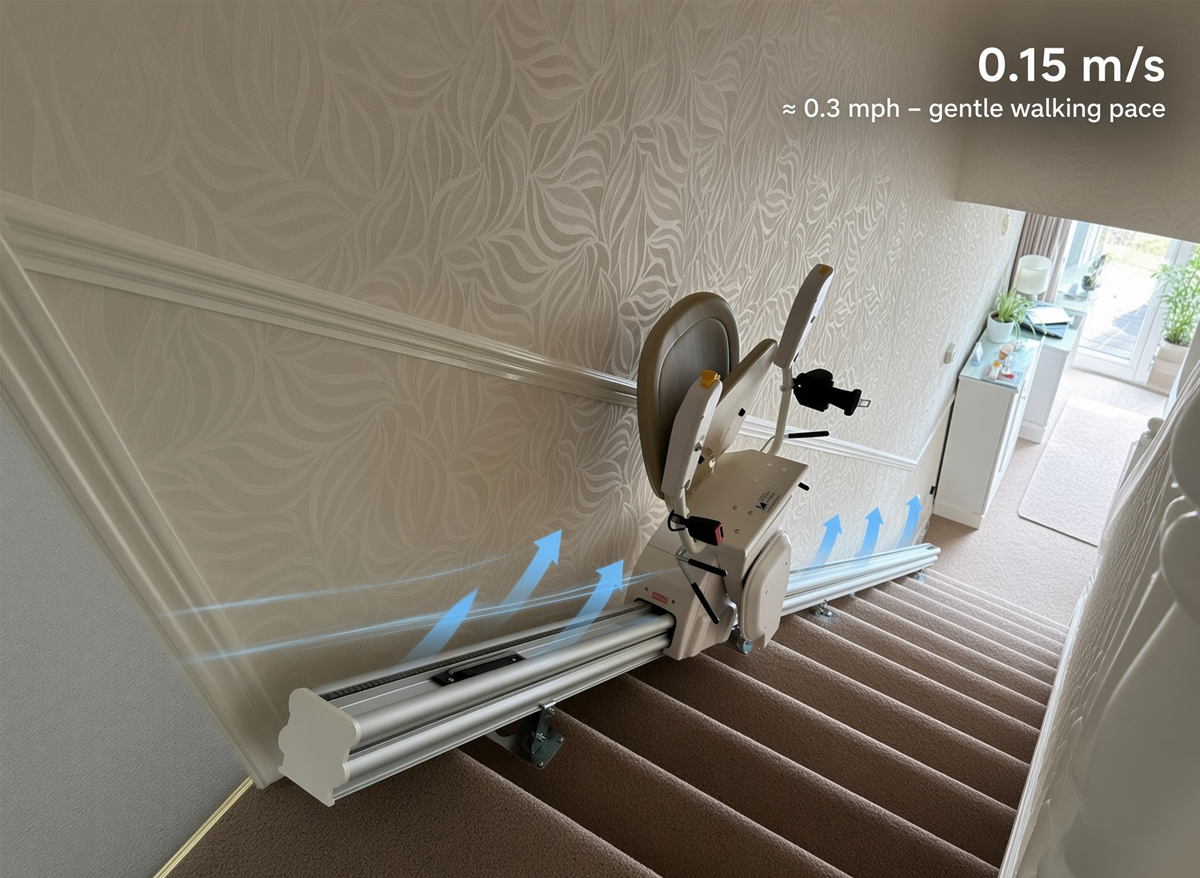
A typical stairlift travels at around 0.15 metres per second, although the exact speed can vary slightly between manufacturers and models.
How long does a stairlift journey take?
On an average straight staircase, a complete journey from the bottom to the top will normally take somewhere around a minute.
Obviously this depends on the length of the stairs. A short staircase may take less time, while a longer flight will take slightly longer.
For most users, the speed quickly feels completely normal after using the lift a few times.
Why stairlifts don’t travel faster
A stairlift could technically be engineered to travel faster, but there wouldn’t be much benefit.
The controlled speed gives the user time to remain comfortable and allows all of the safety systems to operate properly.
It also makes starting and stopping much smoother, especially for someone who may have reduced balance or mobility.
Modern stairlifts normally accelerate and slow down gradually rather than suddenly starting or stopping.
Are curved stairlifts slower?
Curved stairlifts tend to take longer to complete a journey than straight stairlifts.
This isn’t necessarily because the main travelling speed is dramatically different. A curved lift has to follow bends, changes in angle and sometimes several different sections of staircase.
The lift may also reduce speed slightly while negotiating certain bends or transitions.
As a result, a curved stairlift covering the same vertical distance as a straight lift will usually take longer to reach the top.
You can see examples of both straight stairlifts and curved stairlifts on our website.
Does the user’s weight affect speed?
A stairlift operating normally should maintain a fairly consistent travelling speed when used within its specified weight limit.
If a lift becomes noticeably slower than it used to be, especially when travelling upstairs, this can sometimes point towards worn batteries or another issue rather than simply the weight of the user.
A healthy stairlift should feel smooth and consistent throughout the journey.
What does 0.15 metres per second actually feel like?
On paper, 0.15 metres per second sounds very slow.
In practice, that’s exactly what you want from a stairlift. The journey feels steady rather than rushed, and the user has plenty of time to remain comfortably seated.
After a short period of use, most people stop thinking about the speed altogether.
Final thoughts
Most stairlifts travel at around 0.15 metres per second, with an average straight staircase taking roughly a minute from bottom to top.
Curved stairlifts can take longer because they need to negotiate bends, landings and changes in direction.
If you’re considering a stairlift in Nottingham or elsewhere in the East Midlands, Trent Stairlifts can advise on the different models available. You can request a free, no-obligation quote here.
Stairlift speed – FAQs
How fast does a stairlift travel?
Around 0.15 metres per second is typical for many domestic stairlifts.
How long does it take to get upstairs?
Around a minute on an average straight staircase, although it depends on track length.
Are curved stairlifts slower?
The journey generally takes longer because the lift needs to negotiate bends and changes in direction.
Do stairlifts slow down around corners?
Some models reduce speed slightly around particular bends or transitions.
Can stairlift speed be increased?
Stairlifts are designed to travel at a controlled manufacturer-set speed for safety and comfort.
Should my stairlift suddenly become slower?
No. A noticeable reduction in speed can sometimes indicate weak batteries or another fault that should be checked.
post tags :
view related content
Previous Jobs