Can Stairlifts Fit Where Stairs Change Width?
Not every staircase is exactly the same width from top to bottom. Some narrow towards a landing, open out in the hallway or have a section where a wall, newel post or bannister makes the available space smaller.
This does not automatically stop a stairlift being installed. Both straight and curved stairlifts can sometimes work on staircases with changing widths.
The important point is that a stairlift must fit safely through the narrowest section of its journey. Having lots of room on most of the staircase cannot make up for one pinch point where the chair or user does not have enough clearance.
The narrowest section sets the starting point
Imagine a staircase that is 900mm wide at the bottom but narrows to 760mm near the top. For stairlift planning, the wider measurement is not the one that decides whether the lift can travel safely along the full rail.
The engineer starts with the 760mm section and checks what equipment and seated clearance will fit there.
This is the same principle whether the narrow point occurs for one step or continues for several metres. It is the tightest part of the route that often controls the choice of model.
A staircase can have plenty of spare width elsewhere
Once the narrowest part has been assessed, the wider areas usually present fewer problems.
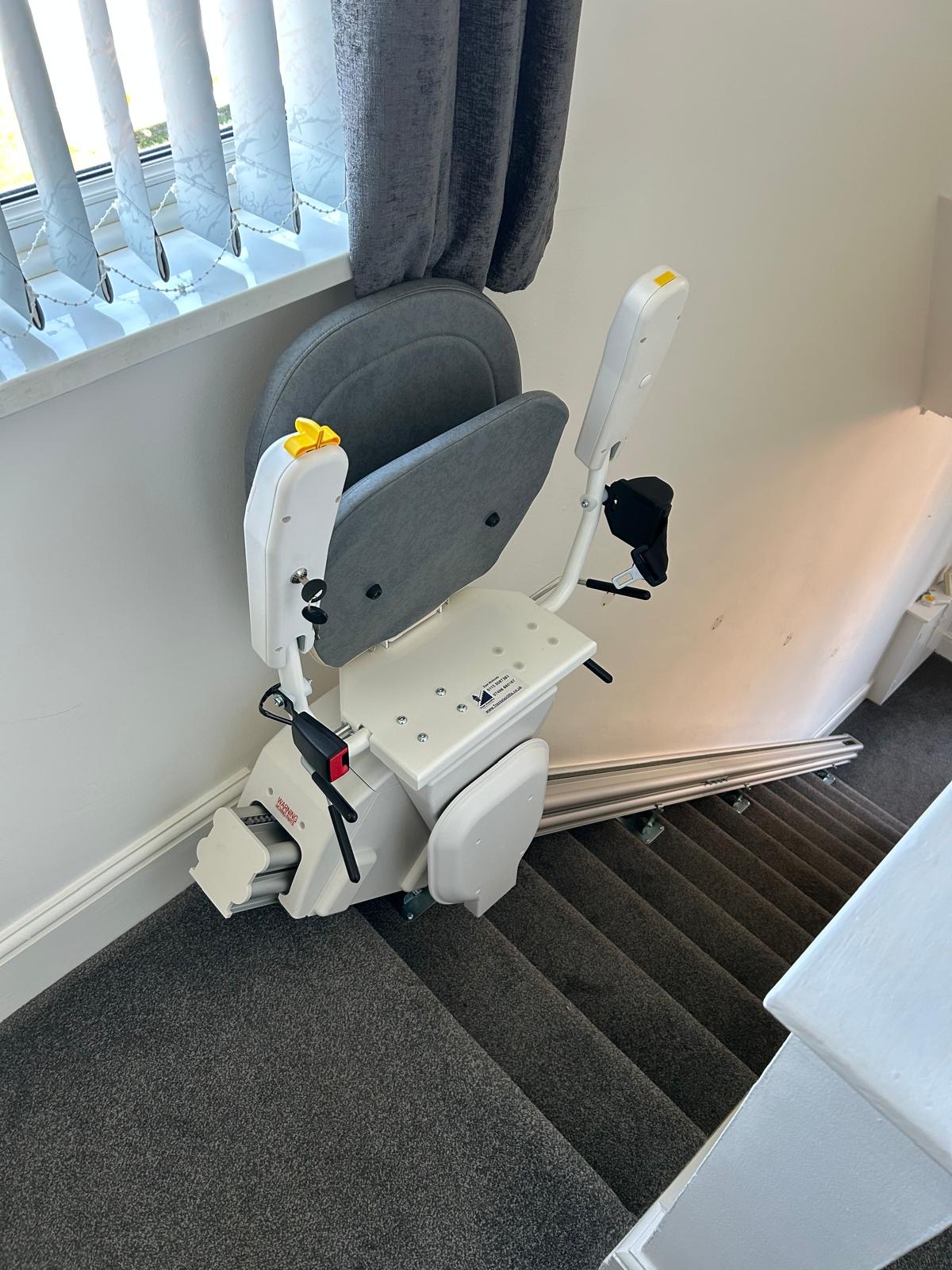
It is quite normal for a stairlift to run beside a wall on a narrower upper section and then have considerably more open space as it reaches the hallway.
The wider section does not necessarily need a different track position. The lift follows its designed route while the remaining clearance simply varies along the staircase.
What measurements actually matter?
The measured width between walls or banisters is only the beginning. A stairlift engineer will also look at the space needed by the chair and by the person sitting in it.
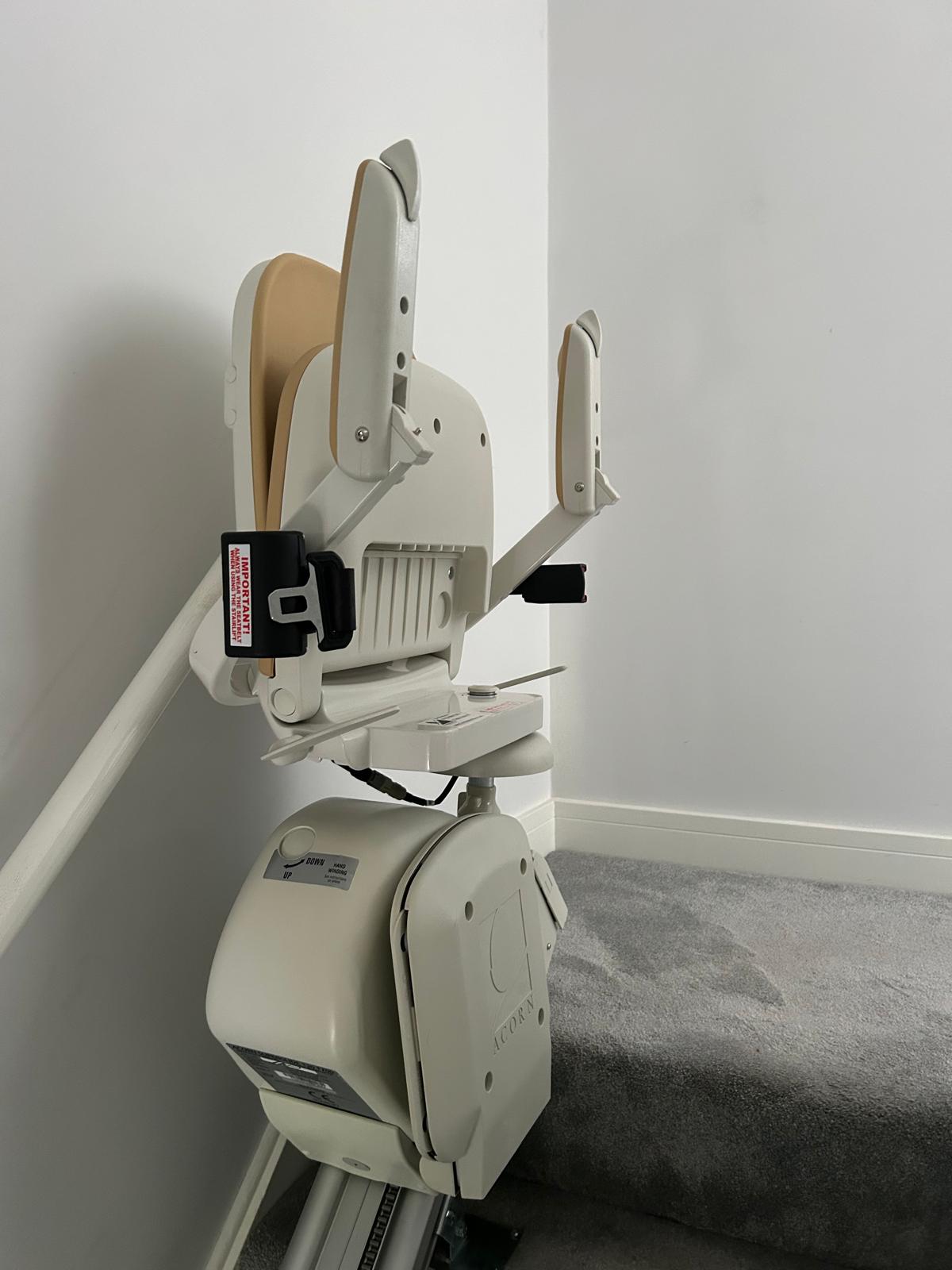
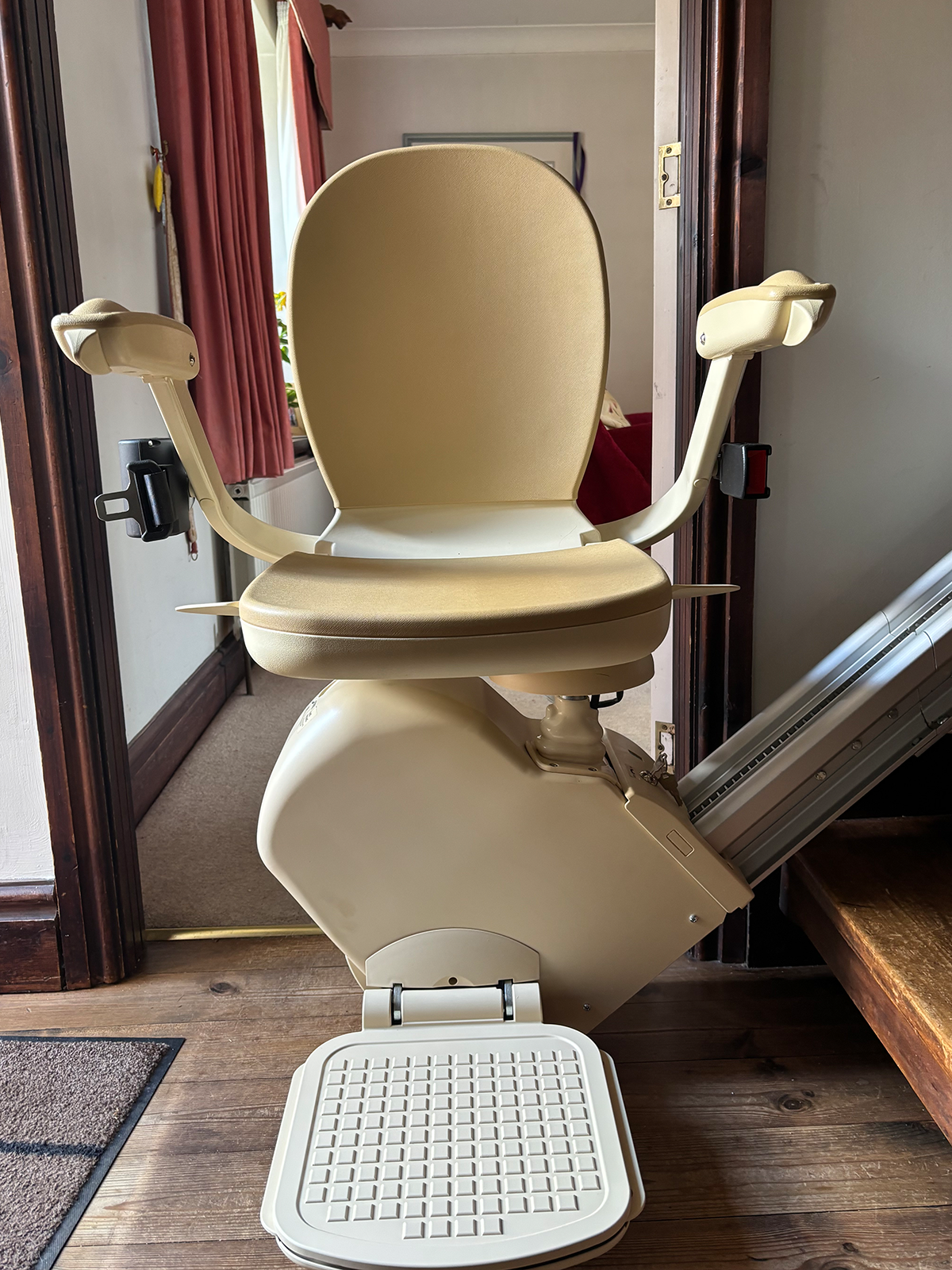
That includes knee and foot clearance, the angle of the rail, how the user sits, and any handrails or trim which project into the space.
An obstruction at shoulder height might matter just as much as a post beside the lower steps. Accurate measurements should be taken at all the tight sections, not merely from skirting board to skirting board.
Can a straight stairlift cope with changing widths?
Usually, yes, provided the staircase remains a suitable straight run and the selected model has safe clearance everywhere it travels.
Changes in width do not in themselves mean the rail needs to bend. A straight rail can follow a straight flight of stairs even if one side of the staircase opens out or moves inward.
The surveyor may recommend a more compact chair or a particular mounting position where the available space is limited. See our straight stairlifts for the types of systems we supply.
What about curved stairlifts?
Curved stairlifts can also deal with changing staircase widths, but the bends introduce additional considerations.
As the chair moves around a corner, the carriage and the seated user may travel through a wider swept area than they do on a straight section. The engineer needs to account for this movement when designing the rail.
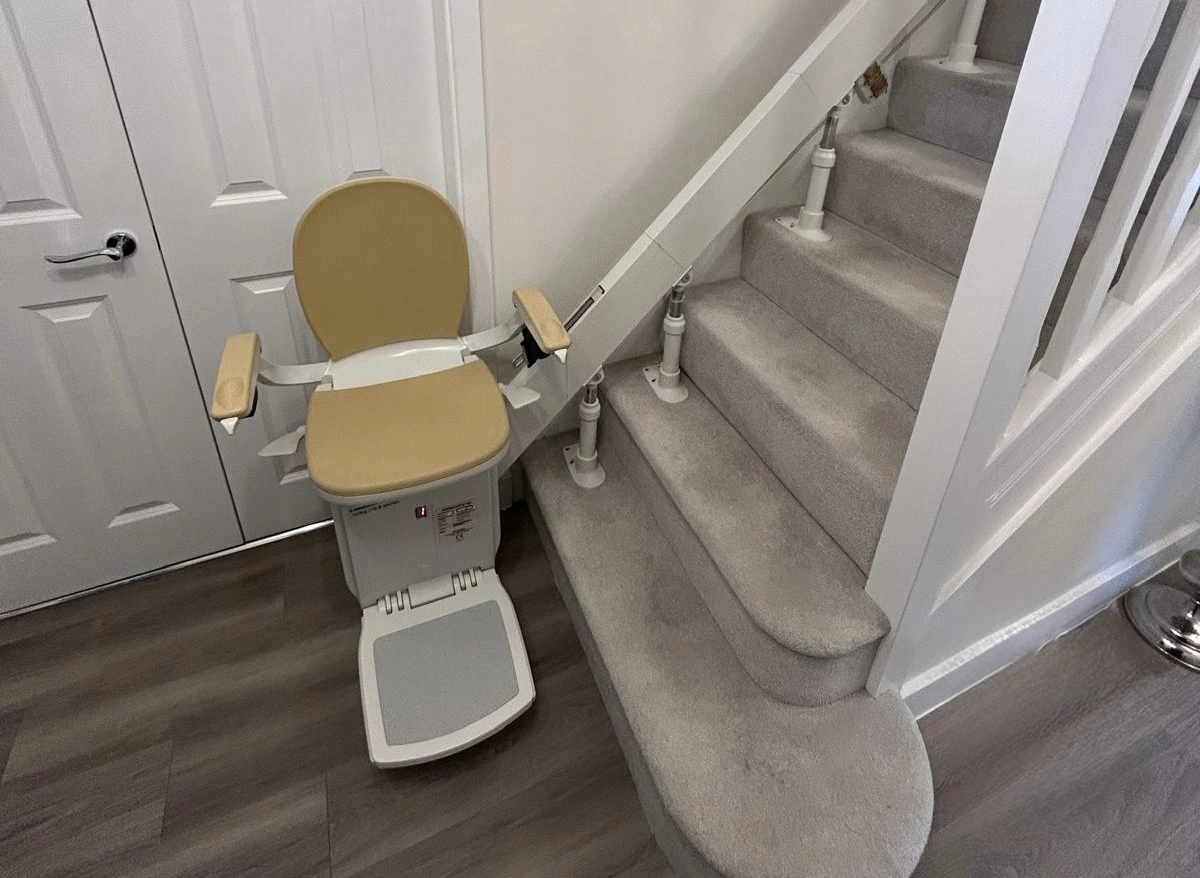
Where possible, a curved rail may be positioned to make the best use of the space available, but not every layout will support every type of carriage. Our curved stairlift range covers the options for stairs with bends and landings.
Posts, handrails and window ledges can create pinch points
Sometimes a staircase is only slightly narrower on paper, but a newel post or handrail bracket is the real restriction.
This is why an on-site survey is useful. The engineer can identify exactly where the obstruction sits relative to the chair, user and rail.
A wall-mounted handrail may be removable in some homes, but bannisters and guarding should not simply be removed to create space. The needs of everybody who uses the staircase must be considered.
The bottom and top landing still matter
Even if the lift can travel through the narrowest point, there still needs to be a safe way to get on and off at the ends.
The top landing may require the seat to swivel towards a clear, level area. A narrow doorway or wall beside the landing can create a problem even where the stairs themselves are wide enough.
At the bottom, the parked chair should not create an unacceptable obstruction in the hallway. Some curved tracks can be designed to turn away from the main stairs where the layout permits.
There is no single width that suits every stairlift
Different models have different folded sizes, seating arrangements, rail positions and minimum installation requirements.
It is tempting to search for one minimum width online and use it as a yes-or-no answer. In reality, the user’s build, the staircase geometry and the chosen equipment all matter.
Trent Stairlifts will look at the narrowest point and confirm what is realistic rather than promising that every machine fits a particular measurement.
Final thoughts
A staircase that changes width is not usually a problem in itself. Many straight and curved lifts can be fitted to stairs that are wider in some areas and narrower in others.
The critical question is whether the stairlift and its user can pass safely through the smallest usable space, and whether the landings allow safe access.
If your staircase narrows towards the top or has an awkward section in Nottingham, Derby, Mansfield or elsewhere in the East Midlands, ask Trent Stairlifts for a free survey and quote.
Frequently asked questions
Can a stairlift fit if my staircase narrows at the top?
Often yes, if the chosen lift has adequate clearance at the narrowest point and a safe top landing.
Does a straight stairlift need stairs to be the same width?
No. A straight stairlift can run on a straight flight whose width varies, provided clearances are suitable.
Can a curved stairlift fit on uneven-width stairs?
Often yes, but the track design and swept clearance around bends must be checked.
Which part of the staircase should I measure?
Measure the narrowest usable section and any obstructions, but a professional survey is needed for a final assessment.
Can a handrail be removed to gain more space?
Sometimes a separate wall handrail can be removed, but staircase guarding should not be casually altered.
Is the narrowest point the only thing that matters?
No. Knee clearance, the rider’s position, top and bottom access, and the folded chair footprint also matter.
post tags :
view related content
Previous Jobs